
Ortona and Moro river Battlefield Tour with a WWII historian and tour guide: ESSENTIAL INFORMATION ABOUT THIS TOUR
- TOUR DURATION: Approximately 6 to 6.5 hours (from 10:00 a.m. to 1:30 p.m.)
- TOUR PRICE: €150 per person(minimum 2 people)
- YOUR TOUR GUIDE: Anna Maria Priora
- MAXIMUM GROUP SIZE: 12 people
- TRANSPORTATION: 1 or 2 vans
- NOT RECOMMENDED FOR YOUNG CHILDREN
- ITINERARY:A guided tour lasting approximately 6 hours and 30 minutes of the most significant American World War II sites in the Cassino area:
- “Battle of Ortona” war Museum
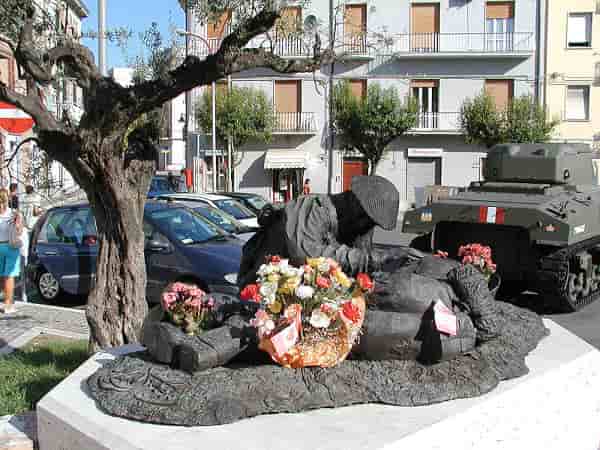
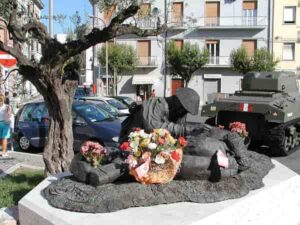
- Price of Peace monument and the town centre of Ortona, the harbour
- Cider Crossroads and the Gully
- Light lunch (not included)
- The Moro river
- Moro river Canadian War Cemetery
- Casa Berardi, Captain Paul Triquet Plaque and XXII Regiment monument
- REVIEWS: ⭐⭐⭐⭐⭐ (Read them here)
- WHAT ELSE CAN I VISIT NEARBY WITH A TOUR GUIDE?
- San Pietro Infine and the Mignano Pass (Mignano gap and Winterline)
- HOW TO BOOK:
Ortona and Moro river Battlefield Tour with a WWII historian and tour guide: HISTORICAL BACKGROUND
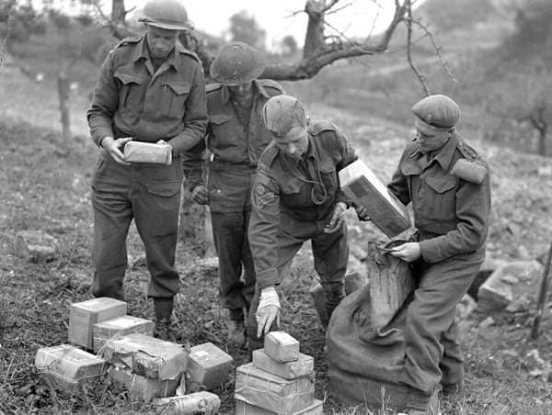
Table of Contents
Trying to reach northern Italy, the Canadians chose the route through Sant’Apollinare and San Leonardo as their main road. On the night of December 4th, the Allies reached the banks of the Moro River. General Vokes ordered his men to send patrols across the river during the night to identify the best crossing points, as the riverbanks were very steep and deep. Vokes decided to follow the old Highway 16 along the Adriatic coast toward Ortona, believing it to be the easiest and quickest route north. By daylight on December 6th, the Canadians had established themselves in Villa Rogatti.
Ortona and Moro river Battlefield Tour: the attack to San Leonardo and the Moro river
The attacks toward San Leonardo, intended as a diversion for the main assault along the coast road, were less successful than expected. The Canadians remained at Villa Rogatti after being counterattacked five times by the Germans of the 200th Panzer Grenadier Regiment. Meanwhile, the Seaforth Highlanders of Canada waded across the Moro River with great difficulty due to its soft riverbed. They managed to secure only a small bridgehead, and after five hours of intense fighting and strong resistance, they decided to hold their position and were reinforced to maintain it.
Ortona and Moro river Battlefield Tour: the Cider crossroad
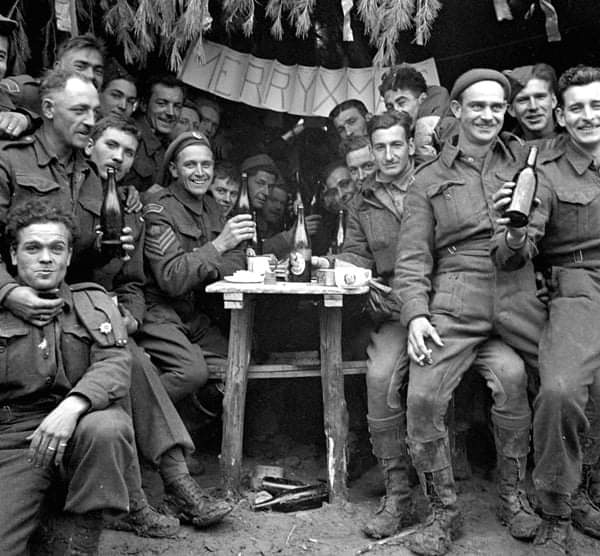
On the right side, near the coast in the San Donato area, the First Brigade decided to attack the junction where a secondary road branched off from the coast road. After very hard fighting and suffering 28 casualties, the battalion was forced to halt and dig in for the night. Despite heavy fighting, the Hastings, through their diversionary action, were the only unit to successfully cross the river. The new plan for the following days was straightforward: on the left flank, the Princess Patricia’s Canadian Light Infantry was to cross the Moro River toward La Torre; in the center, the Royal Canadian Regiment was to launch another attack on San Leonardo; and on the right, after the Highlanders’ assault, the second wave was to secure the road junction known as “CIDER.”

Ortona and Moro river Battlefield Tour: Orsogna and Ortona road
On December 8th, the Hastings had fully crossed to the other side of the river, and the Royal Canadian Regiment launched their attack. They completed a bridge across the Moro River, allowing tanks to cross, but suffered significant losses—21 soldiers were killed on the Ortona battlefield, and 53 were wounded or went missing. After crossing the Moro River near San Leonardo, the Canadians advanced toward the main Orsogna-Ortona road, with a particular focus on what they called the “Cider Crossroads.” Between the Canadians and the Cider Crossroads lay a challenging terrain feature known as “The Gully,” where the 90th Panzer Grenadier Division had established a strongpoint.
Ortona and Moro river Battlefield Tour: the gully a German strongpoint
After several frontal attacks that the Grenadiers easily repelled, General Vokes ordered the 3rd Canadian Infantry Brigade on the night of December 11th–12th, 1943, to flank the most dangerous part of the Gully and advance toward the Cider Crossroads. However, the following German counterattack was so fierce that the West Nova Scotia Regiment and the Carleton and York Regiment were unable to continue the offensive.
On December 14th, the French-Canadian regiment in the Army advanced along a small track on the right side of the Gully, aiming to first reach Casa Berardi and then the Cider Crossroads from the left. But even at the starting line, they came under heavy German mortar and machine gun fire.
Ortona and Moro river Battlefield Tour
Their attack was nearly suicidal, but despite heavy casualties, they managed to reach Casa Berardi. All other units assigned to join them at that location failed to arrive. Of the original 81 men who began the action, only 14 soldiers remained alive, accompanied by just 4 tanks. The survivors established a circular defensive perimeter, with the soldiers positioned in the center and the four tanks covering the four cardinal directions. The following day, they launched several attacks toward the crossroads, but were unable to reach it. The Ortona battlefield proved to be far more difficult than they had anticipated.
Ortona and Moro river Battlefield Tour: Ortona battlefield
General Vokes realized that the Gully was still in German hands and reinforced the Van Doos regiment at Casa Berardi. The operation, called “Morning Glory,” began at 8:00 a.m. on December 18th, 1943, with heavy artillery fire. The 48th Highlanders then advanced and, by the end of the action, had suffered only four casualties. The following operation, however, was unfortunate. The Carleton and York Regiment was temporarily subjected to friendly fire, forcing the cancellation of protective fire and putting the Royal Canadian Regiment in great danger. On December 19th, the First Canadian Division finally reached the Cider Crossroads—bringing them face-to-face with the road to Ortona.
Ortona and Moro river Battlefield Tour: a Bloody victory
On December 20th, the Royal Canadian Regiment and the Seaforth Highlanders of Canada launched an attack on the town of Ortona. After eight days of intense, house-to-house fighting, the German troops withdrew from the town on December 28th. The Canadians suffered heavy losses—1,373 men killed or wounded on the Moro River and Ortona battlefields—accounting for nearly a quarter of all Canadian casualties during the Italian Campaign. Because of its brutality and intensity, Ortona came to be known as the “Italian Stalingrad.”
“Ortona and Moro river” Battlefield Tour with a WWII historian and tour guide: WHAT TO EXPECT
The “Ortona and the Moro river crossing” battlefield tour (about 6 hours) includes:
1)pickupfrom your arrival at the railway station in Ortona every day at 10.00AM
2) about 6h guided tour of the most meaningful sites ofOrtona and the Moro River crossing battlefield:
- “Battle of Ortona” war Museum
- Price of Peace monument and the town centre of Ortona, the harbour
- Cider Crossroads and the Gully
Light lunch (not included)
- The Moro river
- Moro river Canadian War Cemetery
- Casa Berardi, Captain Paul Triquet Plaque and XXII Regiment monument
3)return to the railway station in Ortonaat 05.30PM
“Ortona and Moro river” Battlefield Tour with a WWII historian and tour guide: WHAT YOU MUST KNOW ABOUT THIS TOUR
WHEN AND WHERE:Ortona railway station, every day at 10.00AM (Main entrance)
WHAT IS INCLUDED:a van and ww2 tour guide
WHAT IS NOT INCLUDED:Lunch and dinner are not included
PRICE PER PERSON:price per person from 150 euros (minimum 2 people)
GUIDES/LOCAL EXPERTS:Tiziana Dicembre the local tour guide will held this tour (email dicembre.t@hotmail.it)

“Ortona and Moro river” Battlefield Tourwith a WWII historian and tour guida:More Tours Available in This Area
Monte Cassino Battlefield tour on the footsteps of the Canadians ⭐⭐⭐⭐⭐
Monte Cassino Battlefield Tour on the footsteps of the Canadians in the Liri Valley ⭐⭐⭐⭐⭐
“Campobasso or Canada Town” Grand Battlefield Tour ⭐⭐⭐⭐⭐
Ortona and Moro river Battlefield Tour
The Ortona and Moro river Battlefield Tour 8s held by Anna Maria Priora with Kharen dell'Arciprete, a local guide and WW2 Expert. Price per person
SKU del prodotto:Ortona
Brand di prodotto:Monte Cassino war tours
Valuta del prodotto:Eur
Prezzo del prodotto:150
Prezzo valido fino a:30-12-2030
Prodotto in magazzino:InStock
5